
News
Sustainable Rural Development Growing in Puka
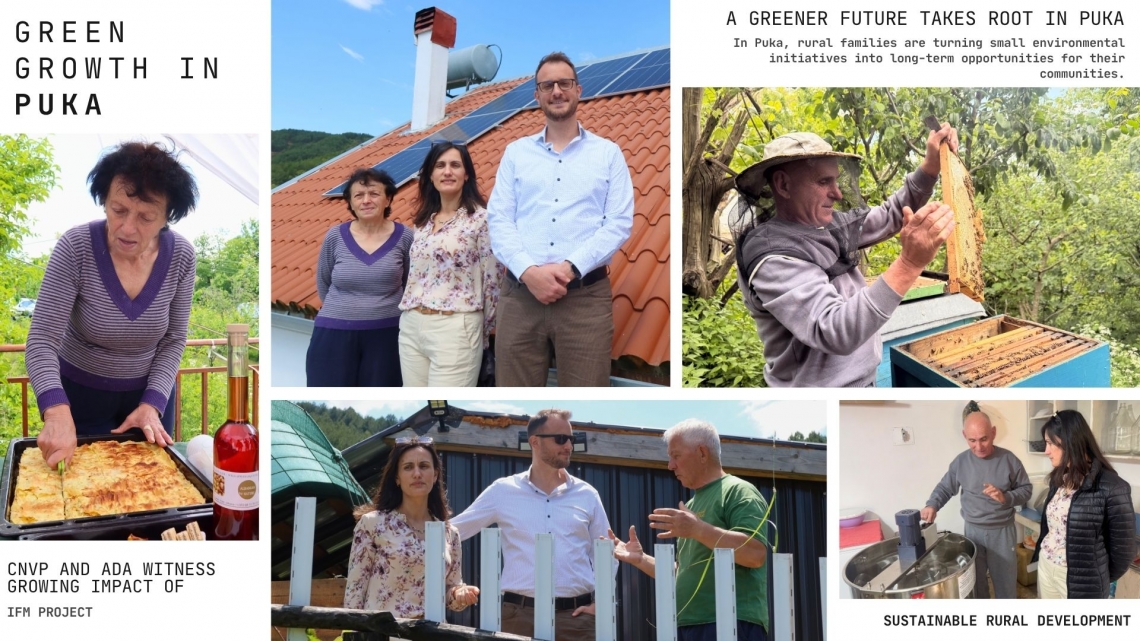
CNVP Foundation and the Austrian Development Agency (ADA) visited yesterday several small grant beneficiaries in the Municipality of Puka to witness firsthand how local communities are turning environmental challenges into sustainable economic opportunities. More than a formal field visit, the activity highlighted the growing impact of the project “Integrated Forest Management (IFM) Along the Drin River Basin,” implemented by CNVP Albania in partnership with the Austrian Association for Global Development - ICEP.
Across the mountainous landscapes of northern Albania, the visit revealed practical examples of how environmental protection, local entrepreneurship, and community resilience can work together.
Through its small grants scheme, the IFM project supports rural families, farmers, women entrepreneurs, and local producers in developing environmentally friendly businesses while protecting forests, biodiversity, and natural ecosystems. The project aims to improve socio-economic conditions for local communities through integrated forest management practices, ecosystem restoration, and climate-smart rural development.
The first stop of the visit was in Qerret, where agro-tourism entrepreneur Marie Shkjau is combining tradition with renewable energy solutions. With more than 20 years of experience in processing forest fruits and hosting visitors, she is strengthening her family business through the installation of a photovoltaic system. The investment is helping reduce energy costs while promoting cleaner and more sustainable operations.
Near Lake Puka, another initiative showed how agroforestry can protect the land while creating long-term economic opportunities. Farmer Halit Dini has transformed sloping terrain into a productive agroforestry area by planting local chestnut seedlings and indigenous fruit trees. Supported by an irrigation system adapted to the terrain, the initiative is helping stabilize the soil, improve biodiversity, and restore greenery in an erosion-prone area.
The social impact of the project was especially visible in the story of Alida Çobaj. After returning from Tirana to her hometown, she established a small fruit processing and drying unit, creating cooperation opportunities for women and girls from nearby villages who supply raw materials for production.
Innovation was also present at the “Raspberry Garden” initiative led by Eliona Mehaj, who is developing a small agricultural business that combines production with branding and digital promotion.
The final stop brought the delegation to the apiary of beekeeper Skënder Morinaj, where traditional honey production is being modernized through environmentally friendly practices. By enriching bee pastures with melliferous plants, expanding the number of hives, and improving processing equipment, the initiative is supporting both biodiversity protection and higher-quality honey production.
Together, these initiatives tell a broader story about the future of rural development in Puka. They show that environmental protection and economic growth are not opposing goals, but processes that can strengthen one another when communities are given the right support and opportunities.
Through the IFM project, CNVP Albania and its Austrian partners are helping local communities build practical solutions that protect forests, strengthen biodiversity, and create sustainable income opportunities at the same time. In Puka, these efforts are gradually shaping a model where people and nature grow together.
The granting scheme is supported by CNVP Foundation with funding by Austrian Development Agency (ADA) as part of “International Partnerships Austria” and initiated by ICEP - Association for Global Development.