
News
CNVP Brings Field Evidence to the CASEE Conference
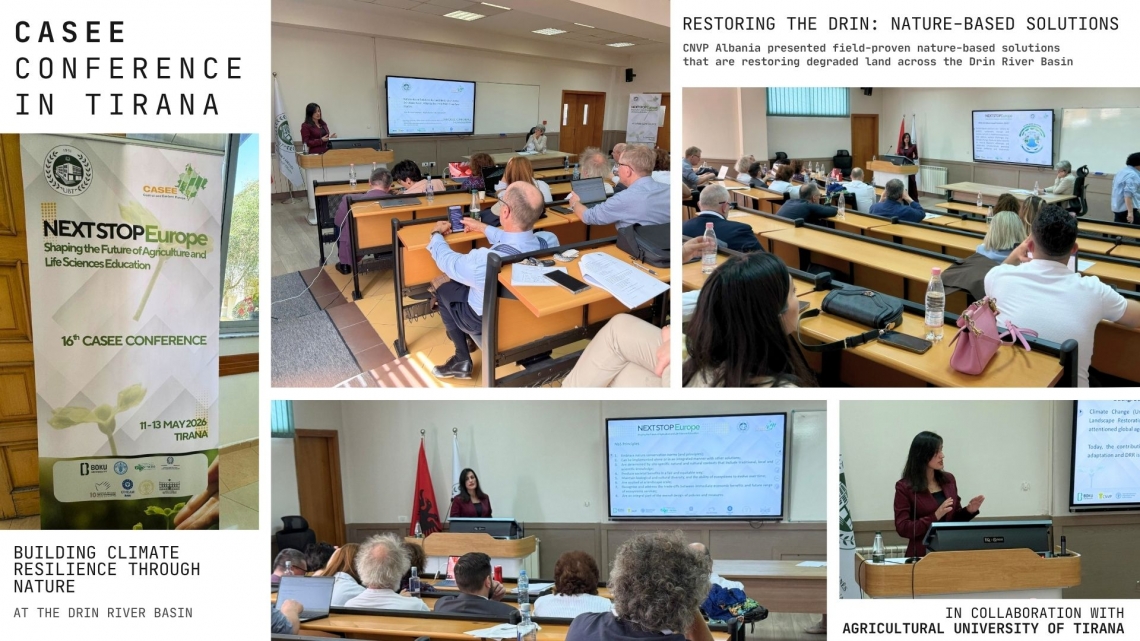
CNVP Albania participated in the CASEE Conference in Tirana, presenting nature-based solutions implemented along the Drin River Basin in Ana e Malit and Qerret.
At the conference, the CNVP Foundation, in partnership with the Agricultural University of Tirana, shared concrete field evidence demonstrating how Nature-Based Solutions (NbS) restore degraded land while directly supporting rural livelihoods.
The focus was the Drin River Basin, a transboundary ecosystem spanning five countries and increasingly pressured by climate change, erosion, floods, drought, and land degradation. Rather than presenting theory, the team showcased measurable results from three field interventions already implemented through CNVP's "Integrated Forest Management Along the Drin River Basin (IFM) project".
In Ana e Malit, 11 hectares of degraded land are being transformed into a mixed, climate-resilient forest. Moving away from vulnerable single-species plantations, the intervention introduced Holm oak, Macedonian oak, and Mediterranean cypress, creating a structure that is naturally more drought-resistant and significantly reduces the risk of human-induced fires. The restoration also integrates olive and cherry trees, linking ecological recovery with food security and income opportunities for local farmers.
Along riverbeds, new plantations of poplar and willow now serve as living barriers against erosion and flooding, stabilizing soil and protecting downstream agricultural land.
In Gomsiqe, the installation of about 400 meters of brushwood check dams, combined with the planting of more than 1800 sweet chestnut seedlings, has already trapped an estimated 12.34 cubic meters of sediment. This directly improves soil stability and water quality, demonstrating how small, nature-based engineering measures can produce immediate hydrological impact.
These examples highlight a clear principle: working with nature is not only an environmental choice but also a practical rural development strategy. By restoring ecosystems, CNVP’s approach simultaneously protects biodiversity, reduces climate risk, and strengthens the economic resilience of local communities along the Drin River Basin.