
News
Get to know Zimbile: From uncertainty to control in the MAPs sector
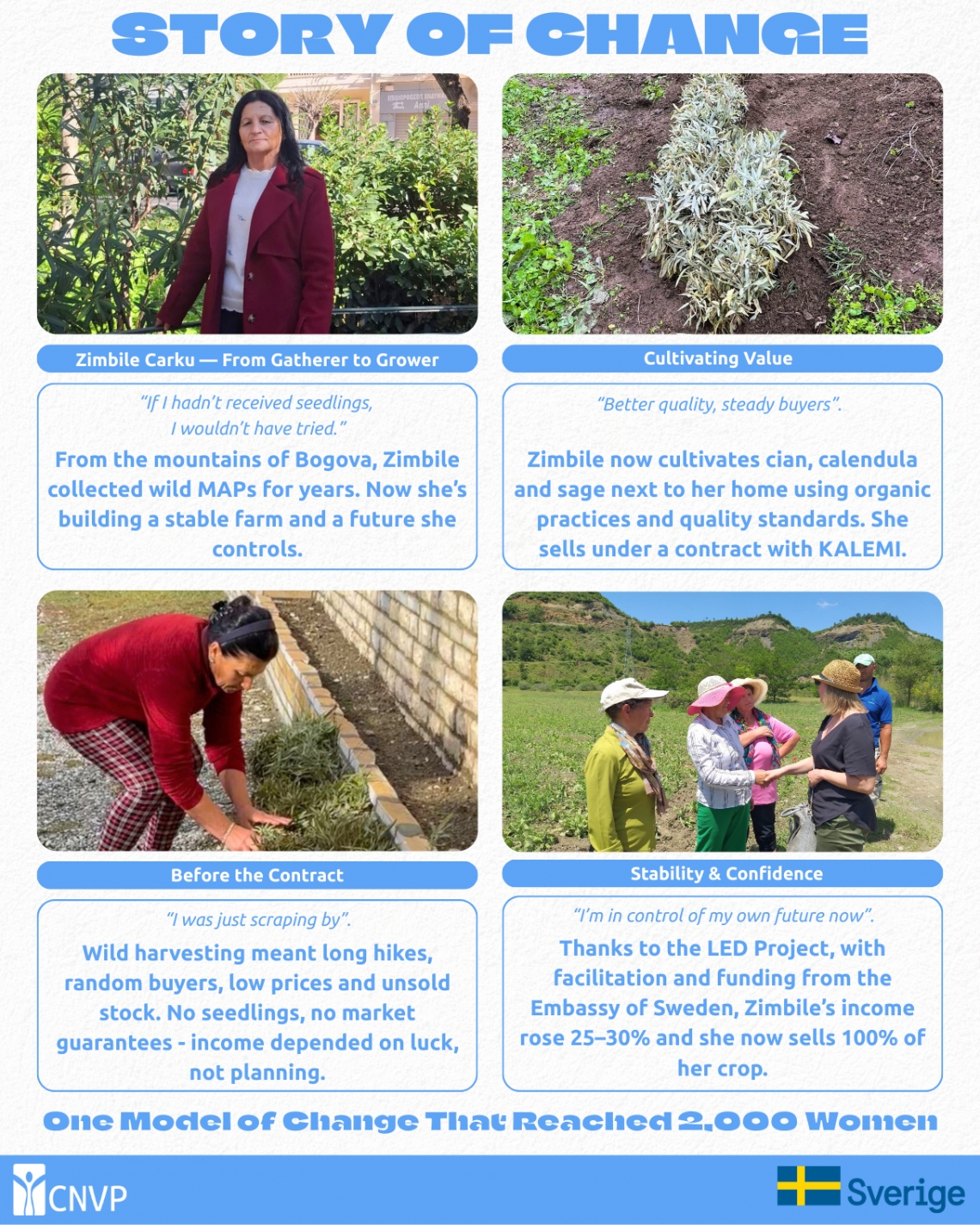
In the small village of Bogova, in Skrapar, opportunities for women to earn a stable income have always been limited. For years, Zimbile Carku relied on collecting wild medicinal and aromatic plants (MAPs) from the surrounding mountains. The work was physically demanding, seasonal, and unpredictable.
She sold her harvest to occasional traders, often facing unstable prices and, in some years, not managing to sell everything she collected. Her income depended on chance rather than planning.
That changed when Zimbile became part of the Local Economic Development (LED) project, implemented by CNVP Foundation with support from Embassy of Sweden in Albania.
Through the project, she moved from wild harvesting to cultivating medicinal plants such as cian, calendula, and sage on her own land. This shift was more than technical, it gave her structure, predictability and control over her work.
A key turning point was access to contract farming. With the project’s support, Zimbile signed an agreement with the local consolidator KALEMI. For the first time, she had a guaranteed buyer, agreed prices, and access to certified seedlings. The initial investment barrier, often a major obstacle for rural women, was removed.
“For farmers, especially women in remote areas, support with initial investments is critical,” Zimbile explains. “Medicinal plant seedlings are expensive. Without this support, I wouldn’t have had the courage to start.”
With training and ongoing technical support, she improved her cultivation practices and adopted organic methods to manage pests and diseases. The results came quickly. Product quality increased, and her income grew by 25–30 percent. Today, she sells all of her production under stable and transparent conditions.
“The moment I signed the contract, everything changed,” she says. “I no longer worry about who will buy my products or how much they will pay. I know I’m getting a fair deal. I feel in control of my future.”
Zimbile’s progress is not only financial. It is about stability, confidence, and recognition. Her experience is now influencing other women in Bogova, who are exploring similar opportunities in MAPs cultivation and contract farming.
Her story reflects a broader shift supported by the LED project. Across Albania, around 2,000 women have gained access to training, investments, and markets — moving from informal and uncertain work toward structured and sustainable livelihoods.
Zimbile’s journey shows a simple but critical point: when risk is reduced and market access is secured, women invest, grow and lead change in their communities.